
Create and Save Custom Scenarios as an Admin
As an Admin in Tenor, you have the ability to create, edit, and save custom scenarios directly into your Scenario Library. This allows for repeatable, consistent practice experiences across your team and gives you full control over how scenarios are structured and stored.
To create and save a custom scenario as an Admin, please follow these steps:
- Log into Tenor and navigate to the Admin Dashboard tab.
- From the Admin Dashboard, go to Manage Library.
- From here, you have two options:
- Click Add Category in the top right to create a new category, and then add custom scenarios within it.
- Click the green + Add Custom Scenario button, also in the top right, to create a scenario directly.

-
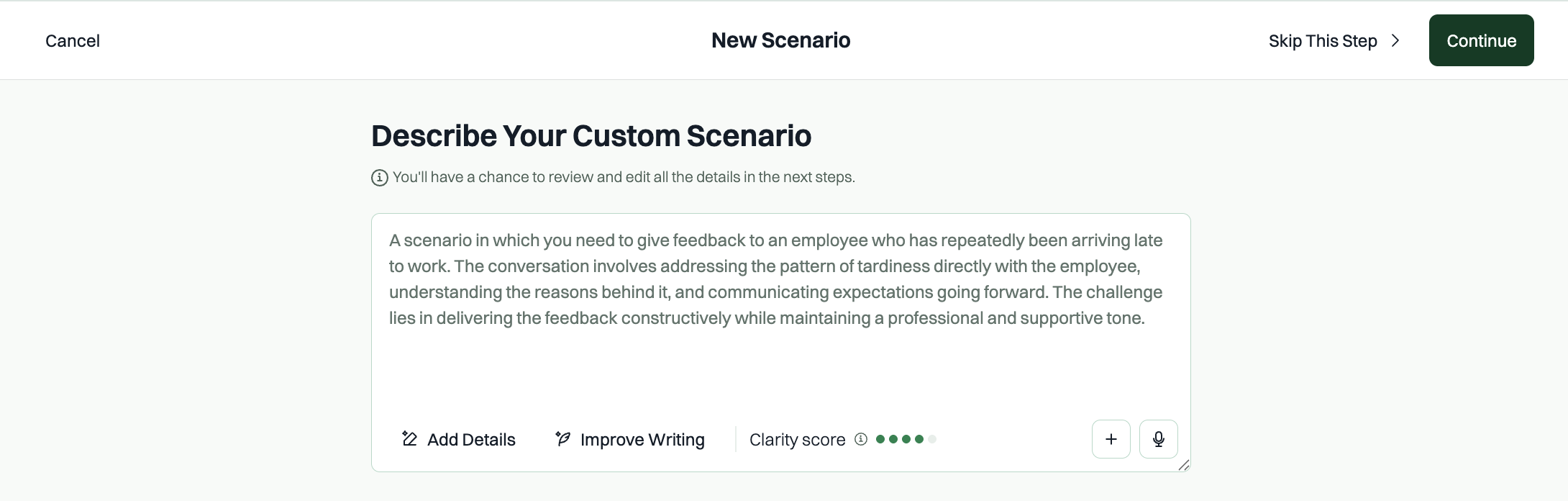
Describe your custom scenario: after clicking Add Custom Scenario, you'll land on Describe Your Custom Scenario. Just type a quick phrase describing what you want to practice — for example, "Give feedback to an employee who has been arriving late." You'll have a chance to review and edit every detail in the next steps, so it doesn't need to be perfect. On this screen, you can:
- Add Details — AI suggests extra context; review the suggestions and approve the ones that make sense.
- Improve Writing — AI rewrites your prompt to make it clearer and more complete.
- Clarity score — shows how clear your prompt is (low to high) and explains what's driving the score.
- + (attach) — add a link or upload a file to give the AI more source material.
- (dictate) — speak instead of typing, and the AI writes it out for you.
When you're happy with it, click Continue.
- Review History & Context: based on what you described, Tenor generates the scenario's background — who's involved, what's happened so far, and the current situation. You can edit the points directly, use Add Details, Improve Writing, or dictate, and you'll see the Clarity score here too.
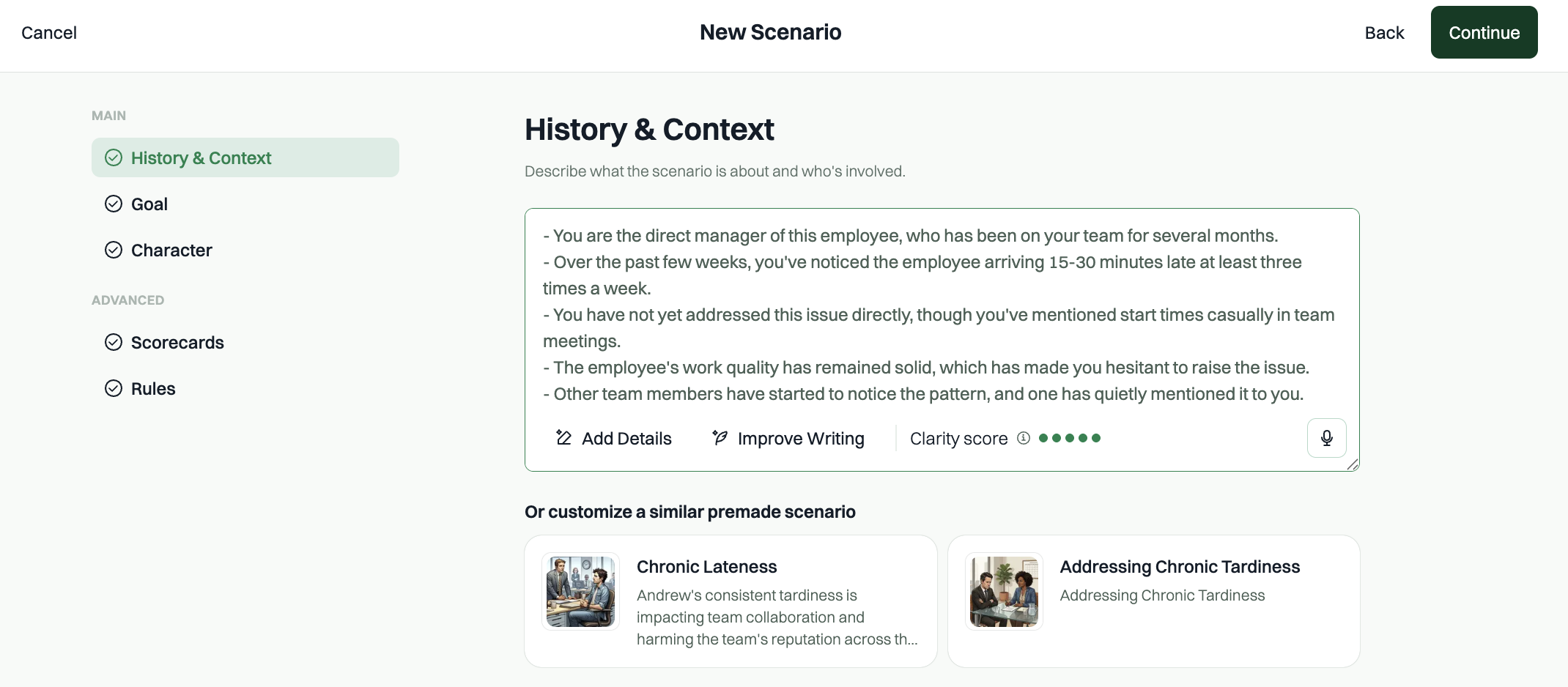
Under "Or customize a similar premade scenario", you'll also see existing scenarios from your library that closely match what you're building. If one of them is a better starting point, select it instead of building from scratch — otherwise, keep going with your new scenario and click Continue.
-
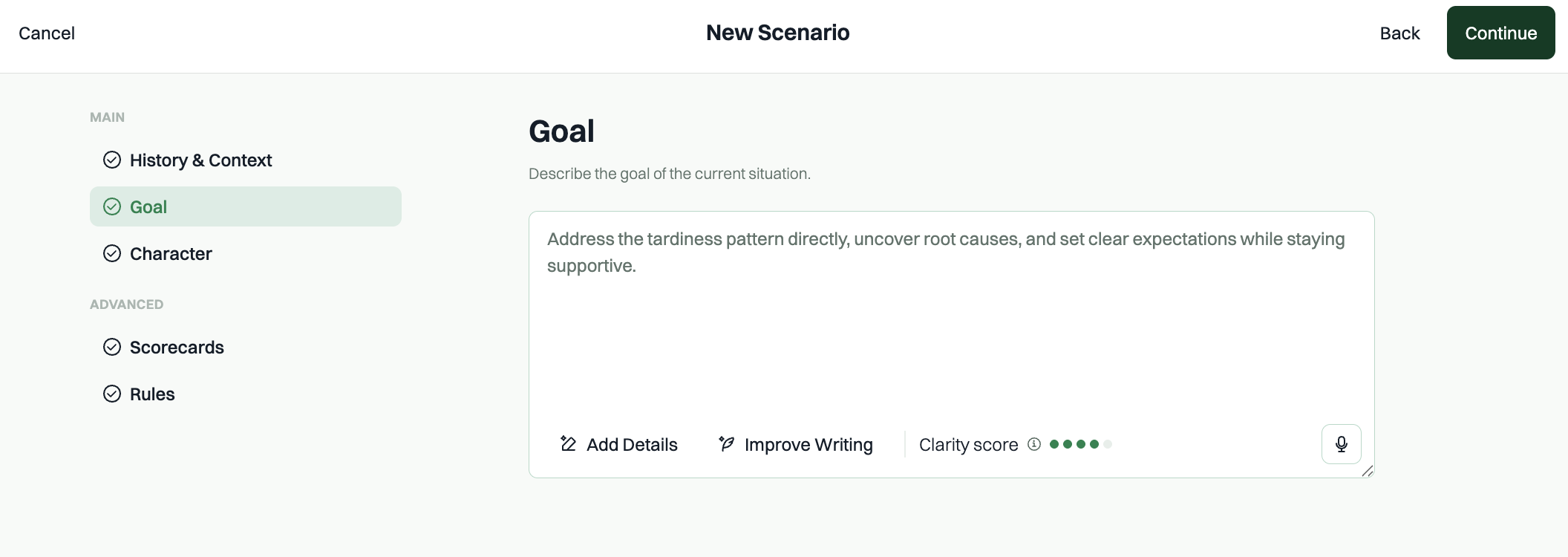
Set the Goal: define what you want the learner to accomplish in the conversation. The same tools are available here: Add Details, Improve Writing, dictation, and the Clarity score. Click Continue.
 7. Choose a Character: Tenor generates three pre-made characters tailored to your scenario, each with a different personality and mood. You can:
- Choose one of them as-is.
- Select one and customize it (name, job title, relationship to you, mood, personality).
- Click Add Custom Character to build one from scratch.
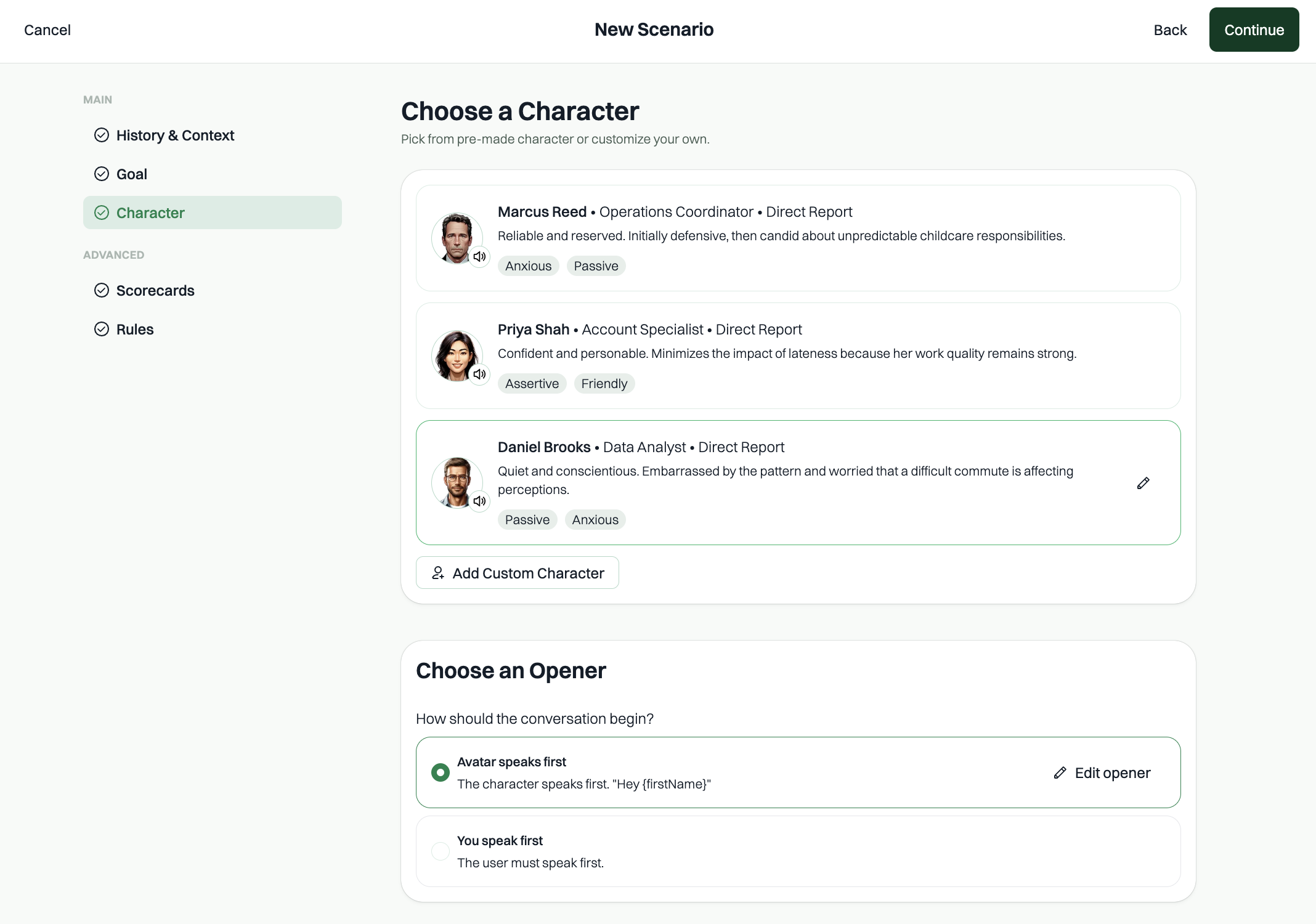
You can also choose an opener. Decide how the conversation begins — Avatar speaks first, or You speak first. If the avatar speaks first, click Edit opener to customize the opening line; use the {firstName} placeholder to have the character say the learner's name. Click Continue.
- Add a Scorecard (optional): select an existing scorecard from your library, or click + Create Scorecard to build one just for this scenario. You can also continue without a scorecard.
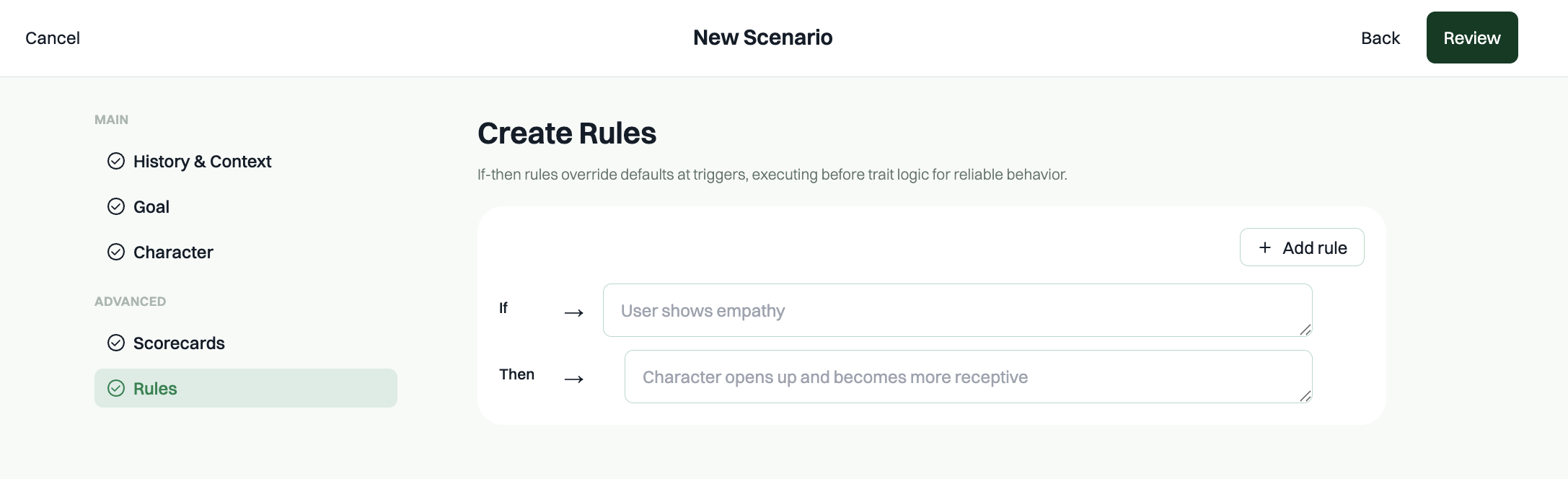
- Create Rules (optional): add as many if-then rules as you like to shape how the character behaves — for example, If the user shows empathy, then the character opens up and becomes more receptive. Rules override defaults at their trigger and run before trait logic, so they're a reliable way to control behavior. Click Review.
-
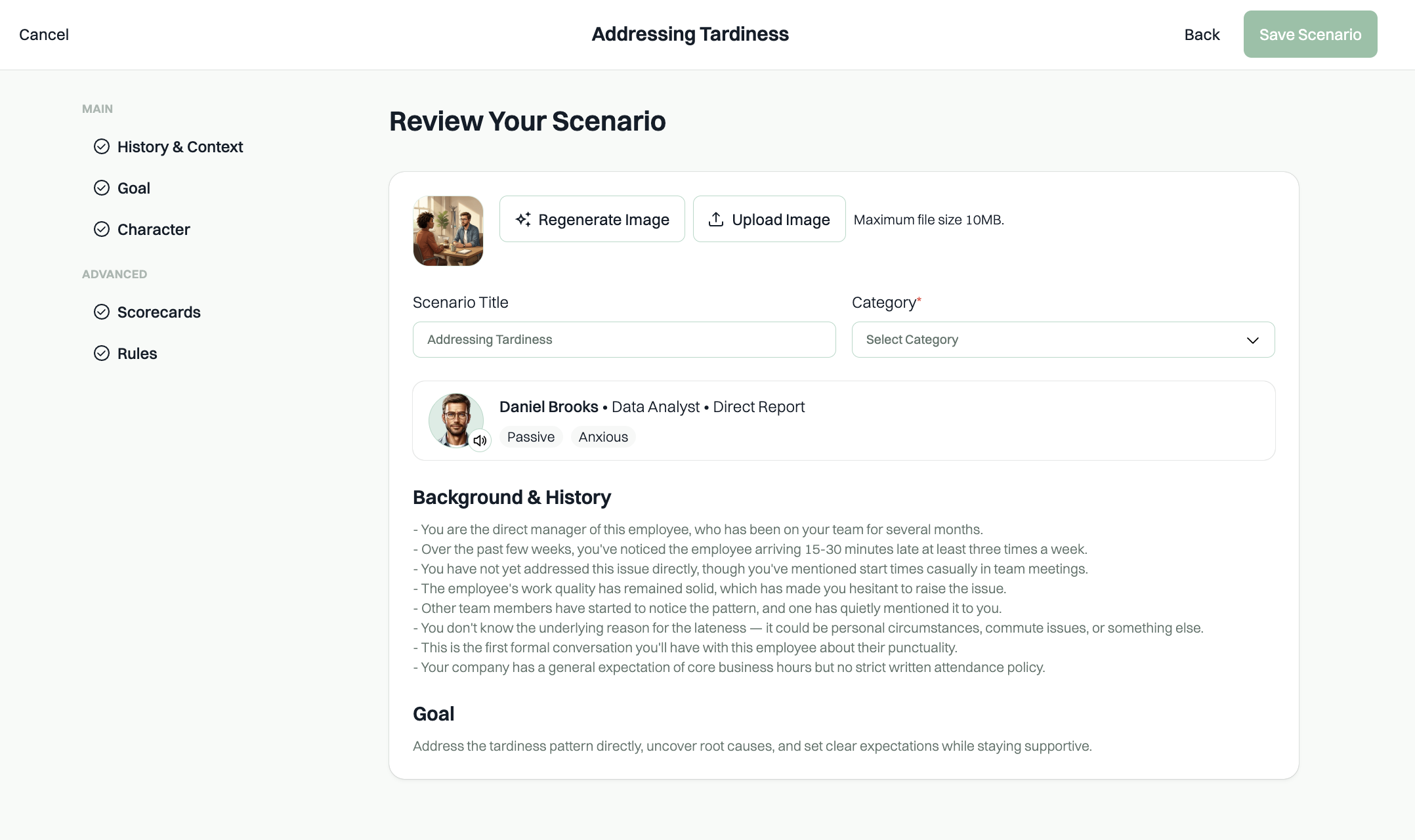
Review and save: on the review screen, you'll see the full scenario: the generated image, the title, the character you'll be speaking with, the background & history, and the goal. Here you can:
- Regenerate Image or Upload Image (max 10MB).
- Edit the Scenario Title.
- Select a Category (required).
⭐️ Quick Note for Admins:
As an Admin, you have the ability to save your custom scenario directly to the library for repeated use and future editing. You can revisit any scenario you’ve created, make updates, and tailor it further based on evolving needs — making this a powerful tool for scalable and flexible practice design across your team.